
UNIFYING THE VOICES OF HYDROPOWER
WEBINAR RECAP VI - Boosting Hydropower V: Best Practices for Research
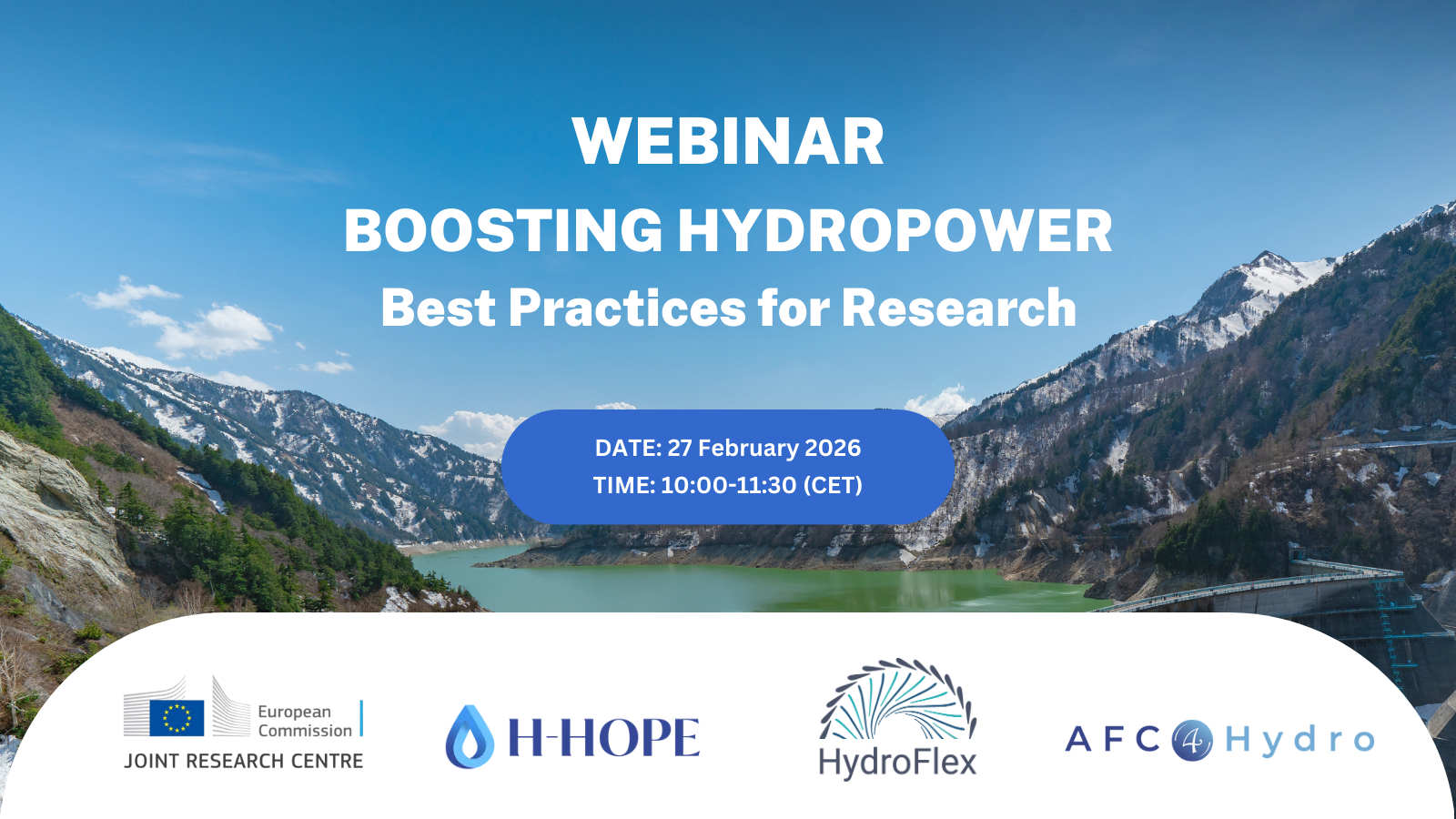
On 27 February 2026, the latest session of the “Boosting Hydropower” webinar series, organised by the ETIP HYDROPOWER project, brought together leading experts to present key EU-funded initiatives advancing hydropower flexibility, efficiency and innovation. The session featured the AFC4Hydro, HydroFlex and H-HOPE projects - two of which have already concluded - alongside a presentation of the latest Clean Energy Technology Observatory (CETO) Report by the European Commission’s Joint Research Centre (JRC).
The webinar highlighted hydropower’s evolving role within Europe’s energy transition, showcasing technological developments that strengthen system flexibility, unlock untapped potential in existing infrastructure, and improve turbine performance under increasingly dynamic operating conditions.
Clean Energy Technology Observatory (CETO) Report: Hydropower Market and Trends
Emanuele Quaranta, Senior Scientific Officer and hydraulic engineer at the European Commission’s Joint Research Centre, opened the technical session with the presentation of the latest CETO Report.
As lead of the hydropower section of the Clean Energy Technology Observatory, Quaranta provided an overview of hydropower’s role in the EU energy mix, analysing its market status, technological trends and future outlook. The presentation addressed the contribution of hydropower to system flexibility, the evolution of installed capacity across Member States, and innovation pathways aligned with sustainability and the Water–Energy–Food–Ecosystem nexus.
The CETO report offers valuable insights into how hydropower can continue to support decarbonisation while meeting environmental and resilience objectives.
H-HOPE: Recovering “Hidden” Hydropower in Water Infrastructure
Giovanna Cavazzini, Associate Professor at the University of Padova, presented the H-HOPE project (Hidden Hydro Oscillating Power for Europe), which explores innovative solutions to recover untapped hydropower potential embedded in existing water and wastewater infrastructure.
H-HOPE focuses on integrating small-scale hydropower technologies into drinking water and wastewater networks, enabling energy recovery without requiring new large-scale infrastructure. By combining advanced hydraulic design, digital monitoring, and system optimisation, the project supports the digitalisation, resilience and energy efficiency of water networks.
This approach demonstrates how distributed, low-impact hydropower solutions can contribute to local decarbonisation strategies while reinforcing infrastructure sustainability.
HydroFlex: Increasing the Value of Hydropower Through Flexibility
Ole Gunnar Dahlhaug, Professor at the Norwegian University of Science and Technology (NTNU) and leader of research activities at the Waterpower Laboratory, introduced the HydroFlex project.
HydroFlex addresses one of the central challenges of the energy transition: enabling hydropower plants to operate with high flexibility in power systems with increasing shares of variable renewable energy such as wind and solar. The project demonstrates how hydropower can provide fast ramping, frequency control and grid balancing services while maintaining technical feasibility, environmental responsibility and long-term asset integrity.
Through research, testing and system-level analysis, HydroFlex reinforces hydropower’s role as a backbone technology for grid stability in a climate-neutral energy system.
AFC4Hydro: Active Flow Control for Improved Turbine Performance
The final presentation was delivered by Xavier Escaler, Associate Professor at the Barcelona School of Industrial Engineering and leader of the Barcelona Fluids & Energy Lab (IFLUIDS). He presented the AFC4Hydro project, which developed and validated an innovative Active Flow Control (AFC) system for large hydraulic turbines.
AFC4Hydro enhances turbine flexibility and efficiency, particularly under off-design operating conditions that are becoming increasingly common due to fluctuating grid demands. By actively controlling flow behaviour inside the turbine, the system reduces mechanical stress, mitigates instabilities, and improves overall performance.
The project’s results demonstrate how advanced monitoring, diagnostics and fluid-dynamics-based solutions can extend turbine lifetime and enable hydropower plants to adapt to more dynamic operating regimes.
The webinar reaffirmed the strategic importance of research and innovation in strengthening hydropower’s contribution to Europe’s clean energy transition. By combining policy insight through the CETO report with concrete technological advancements from EU-funded projects, the session provided a comprehensive overview of the sector’s progress.
You can rewatch the webinar on our YouTube channel or via the recording available below: